
Challenge with Monitoring Correctional Medical Facilities
Sensor Fusion and Thermal Monitoring:
A Privacy-First Approach to Safety in Correctional Medical Spaces
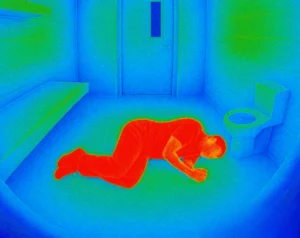
Correctional infirmaries, medical rooms, and exam spaces present a unique challenge: how to ensure safety for incarcerated individuals, clinical staff, and correctional officers—while still respecting medical privacy and compliance requirements.
Traditional video surveillance often cannot be used in these environments due to HIPAA standards and ethical concerns. Yet the absence of monitoring can create dangerous blind spots. As recent high-profile cases demonstrate, the lack of visibility in medical areas can lead to severe safety failures, legal exposure, and loss of public trust.
This raises an essential question for correctional leaders: Are there alternatives to traditional cameras that maintain safety without violating privacy?
The Limits of Cameras in Medical Settings
Most stakeholders agree that incarcerated patients deserve privacy during medical exams, treatment, and recovery. Infirmaries are intended to be safe, controlled environments for care—not areas of unchecked risk.
However, live-feed cameras and body-worn cameras pose significant challenges:
-
They may violate HIPAA and patient privacy expectations
-
They can discourage honest medical disclosure
-
They create legal and ethical concerns around recorded medical encounters
As a result, many facilities restrict or prohibit cameras in medical areas—sometimes leaving staff without adequate oversight or documentation.
Sensor Fusion Technology: Monitoring Without Surveillance
Emerging sensor fusion technologies offer a new way to balance safety and privacy in sensitive correctional environments.
Sensor fusion combines data from multiple non-invasive sensors—such as radar, thermal imaging, and computer vision—into a single, unified understanding of activity within a space. Rather than capturing identifiable video footage, these systems analyze movement patterns, presence, and environmental conditions.
When paired with artificial intelligence (AI), sensor fusion systems can:
-
Detect unexpected movement or inactivity
-
Identify falls or erratic behavior
-
Monitor room occupancy without visual identification
-
Trigger alerts without streaming live video
This approach enables continuous awareness without constant visual surveillance.
Privacy-Preserving Monitoring in Correctional Infirmaries
Thermal imaging and radar-based monitoring allow facilities to maintain oversight while minimizing privacy risks. These systems focus on behavioral indicators, not personal identity.
Key advantages include:
-
No reliance on traditional video feeds
-
Reduced exposure of private medical interactions
-
Improved compliance with privacy and medical standards
-
Continuous monitoring during high-risk situations, such as detoxification or medical observation
This technology is particularly valuable in infirmaries, mental health observation rooms, and exam spaces where both privacy and safety are critical.
Applying Sensor Fusion in Corrections with Cell-Guardian
One example of this technology in practice is Cell-Guardian, a zero-touch inmate monitoring system designed specifically for correctional environments.
Cell-Guardian uses sensor fusion—including radar and thermal imaging—to monitor movement and environmental conditions without requiring wearables or intrusive cameras. Units can be mounted to walls or ceilings and accessed through a secure, browser-based interface, allowing for integration with existing correctional systems.
Capabilities include:
-
Detection of movement, falls, or prolonged inactivity
-
Real-time alerts when abnormal behavior occurs
-
Monitoring of individuals experiencing medical distress, detoxification, or mental health crises
-
Time-stamped event records to support accountability and review
By providing continuous, non-invasive oversight, systems like Cell-Guardian give staff an additional layer of situational awareness in areas where traditional monitoring is limited or inappropriate.
The Future of Privacy-First Monitoring
As sensor fusion technology continues to evolve, future applications may include:
-
Detection of respiratory and heart rate patterns
-
Faster identification of medical emergencies
-
Early alerts for physical altercations or unsafe one-on-one interactions
These advances have the potential to improve outcomes while reducing staff strain and enhancing care standards in correctional settings.
Moving Forward
Correctional facilities no longer need to choose between privacy and safety. With modern sensor fusion and thermal monitoring technologies, agencies can protect incarcerated individuals and staff while respecting medical confidentiality.
Privacy-first monitoring represents a meaningful step forward in correctional healthcare, safety, and accountability—one that aligns technology with humane, responsible operations.